Production and grades
How a workshop picks what to make, how long a cycle takes, and where extra goods come from.
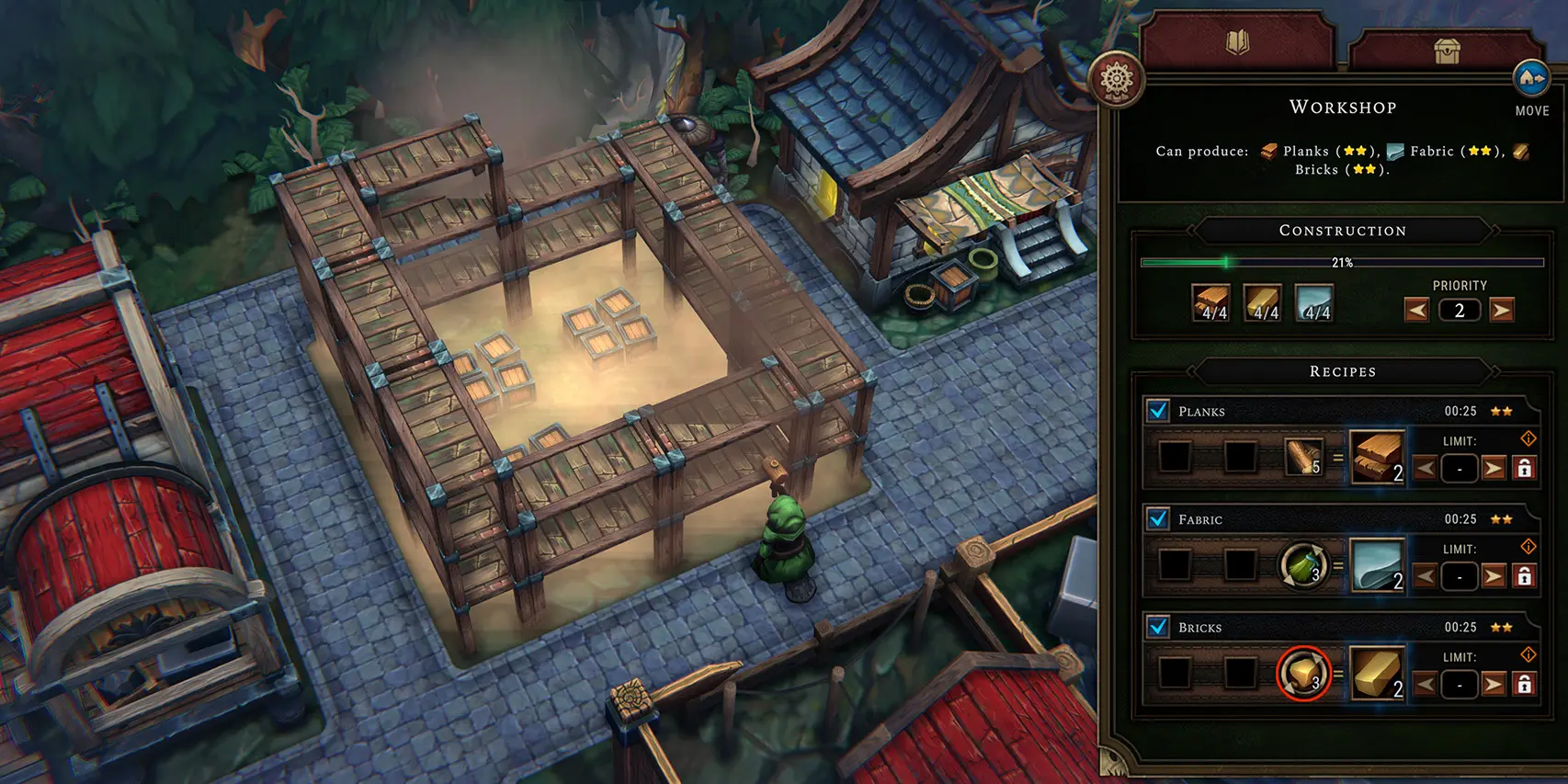
Picking a recipe
Each worker slot in a building runs its own production. When a slot finishes, it looks for the highest priority recipe that is switched on, still under its limit, and has ingredients in reach. If two recipes tie, the one that has waited longest wins.
An ingredient slot is a choice, not a shopping list. A slot that shows three goods needs any one of them, which is why a workshop keeps running when a single input dries up.
Cycle time
Workshop recipes have a production time in seconds. Farms use separate planting and harvesting work, while gathering sources depend on their own collection and restock rules. The production planner estimates worker demand and ingredient use for continuous workshop production at the chosen speed and proficiency. Travel, breaks and seasonal gathering are outside that estimate.
Output and extra production
A finished cycle yields the recipe's base amount plus any raw production bonus for that good, scaled by the building's production factor.
On top of that sits the chance for extra goods. Chances from the recipe, a global bonus, a recipe tag bonus, a villager perk, the worker's profession and the building's upgrade all add into one number. The whole part is guaranteed: a total of 1.4 always gives one extra stack, then rolls the remaining 0.4 for a second. A separate chance, carried by a few penalties, can zero a cycle outright.
Grades
Recipes are graded, and the grade badge on a recipe page is the same one the game prints in the building panel. Camps, farms, mines and fishing huts run their own recipe families with their own restock and seasonal windows, which is why a farm produces in bursts and a workshop produces steadily.