Traders and trade routes
What a good is worth, how a trader's visit works, and how trade route standing compounds.
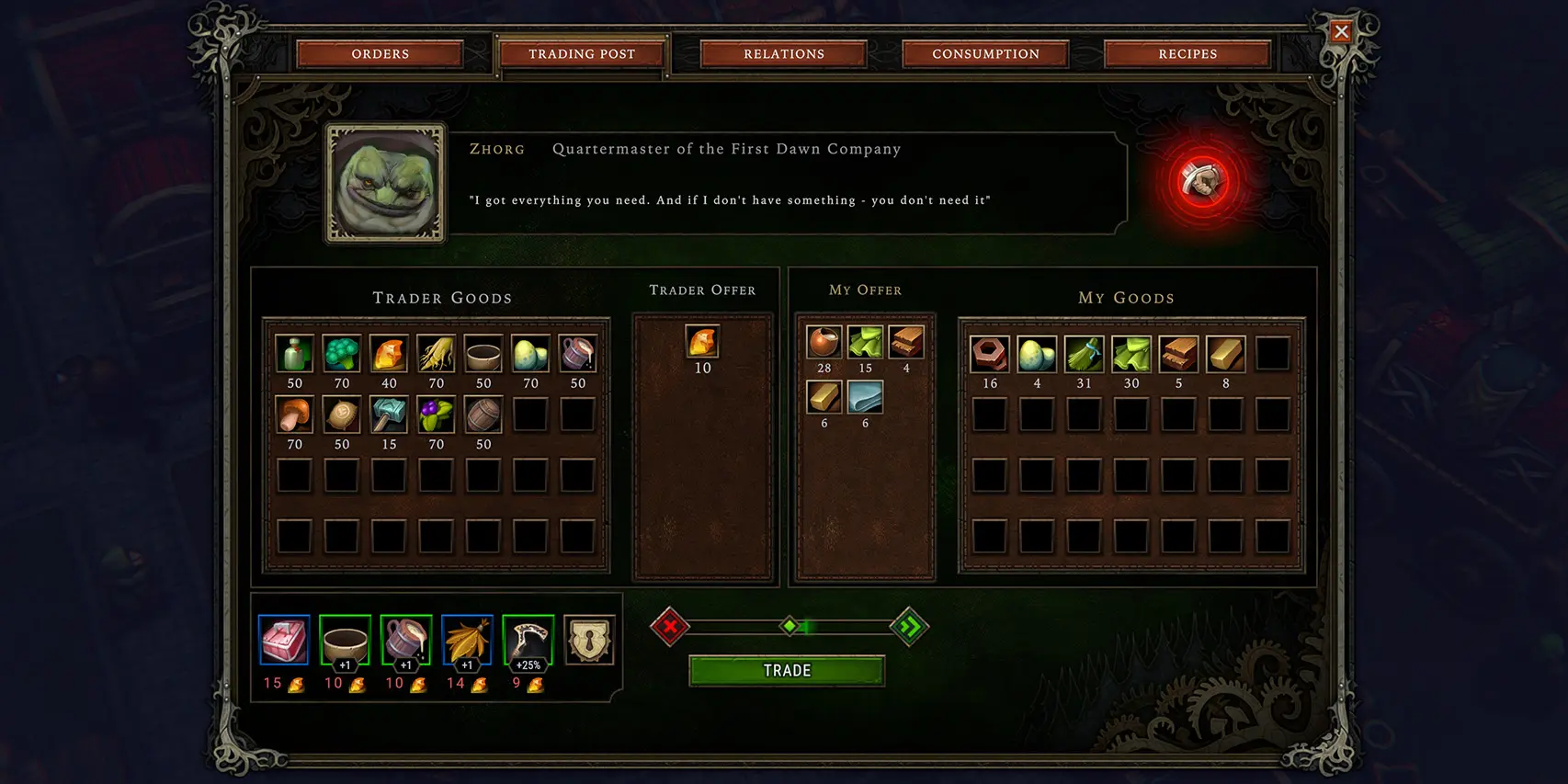
Amber is the currency. Every good page shows two numbers: what a trader pays you for one, and what the same trader charges you for one. The gap between them is the trader's cut, and it is why buying and reselling the same good loses money.
A barter is allowed when the trader's side of the scale is worth something and the balance is not tilted against them. Perks and effects on sale are priced the same way, from the effect's own value in Amber.
Visits
Which trader comes next depends on your city score, which opens up wider pools as the settlement grows. The draw is weighted, and the game avoids sending the same trader twice in a row when it has a choice. A trader you have assaulted never returns.
Regular traders have a base travel requirement of 675 seconds and a base stay of 80 seconds. The specialist visitors Alune Soulgazer, Gex Runescale and Ruenhar Blightclaw use 720 and 120 seconds. Travel progress pauses during the Storm and arrival requires a completed Trading Post; effects can change the travel rate. Calling a trader early advances the trip to 97%. Its base Impatience price starts at 0.5 and doubles with each use, before any flat price adjustment, and calling is blocked when the Storm is too close.
Every visit brings a set of guaranteed goods plus a weighted draw of others, and a list of perks for sale. If you have unlocked the discount, one of those perks is offered at half price.
Trade routes
Trade-route partners are selected at embark, with up to four partners in total. Nearby world cities are preferred; the Citadel and unlocked faction districts fill spare places within that same cap. Each partner starts with two offers for goods it wants, and its simultaneous offers do not repeat the same good.
An offer is generated by splitting a random budget across four knobs. These determine how much it wants, what it pays, the fuel it costs and how long the trip takes. Standing with the town pulls those knobs in your favour, raising the amount and the payment while cutting the fuel and the travel time.
Collecting a route adds its recorded payment to that partner’s Standing progress. Level costs are incremental. The next levels require 10, 20, 35, 50 and 75 additional points, so their cumulative base thresholds are 10, 30, 65, 115 and 190. Excess progress carries into the next level. You can buy up to three additional offer slots, taking a partner from two offers to five. They cost 5, 10 and 15 Amber; completing three routes is not a prerequisite.