World map generation
How the hex world is built each cycle, where seals land, and how events and modifiers are placed.
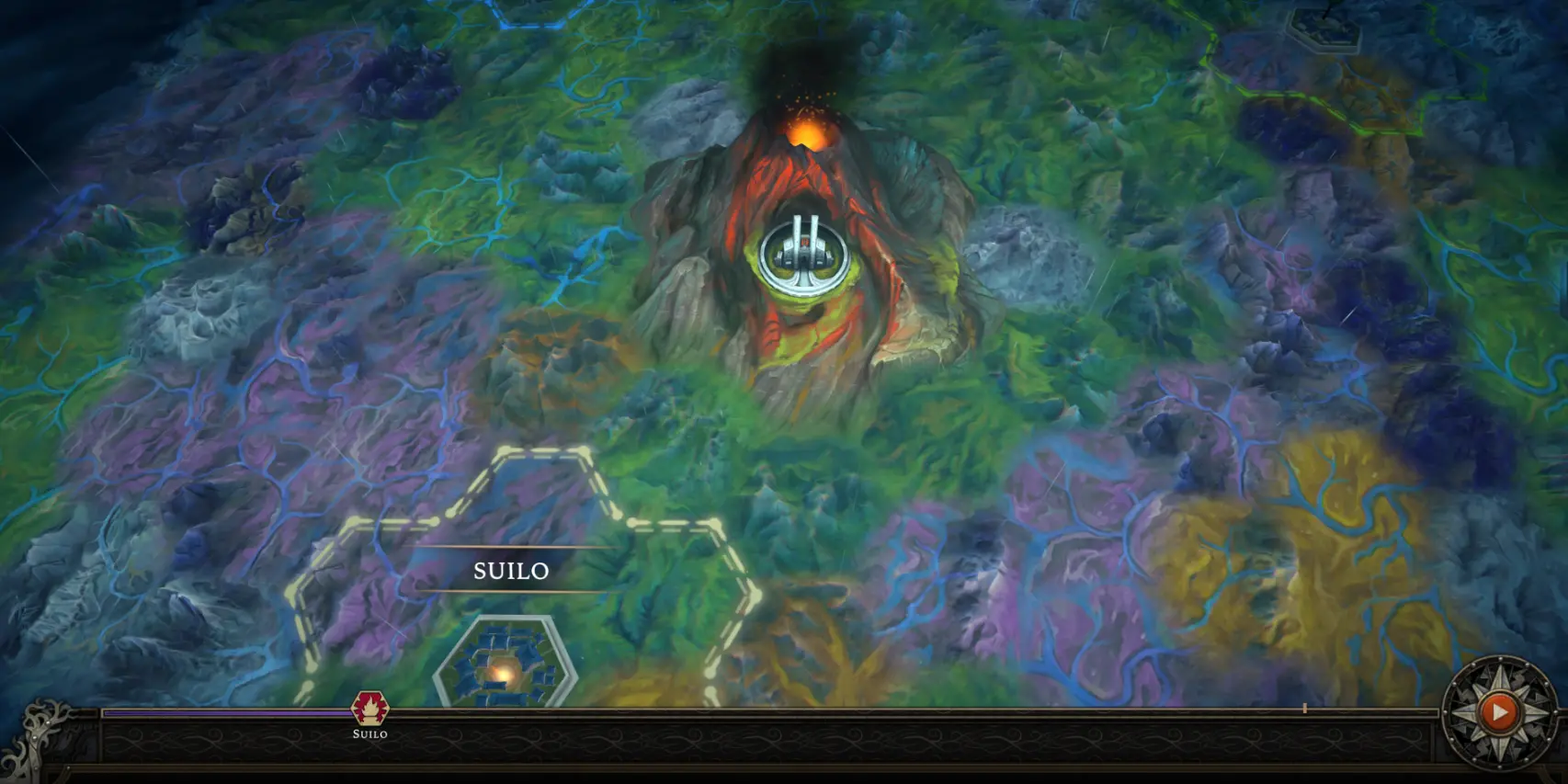
The world map is a hex grid rebuilt from a seed every cycle. It runs 30 fields out from the centre in each direction, which comes to roughly 2,800 fields.
Biomes
Initial fields draw weighted accessible biomes. A biome is eligible only beyond its configured minimum distance from the Citadel. The later smoothing passes use neighbouring biomes without rerunning that initial distance filter.
The map then runs two smoothing passes. A field flips to whichever biome most of its neighbours hold, but only when at least four of the six agree. Two passes is enough to turn scattered noise into the continents you actually travel across. The capital is placed last, at the exact centre.
Seals
You can contract up to three seals. Normal world generation places four copies when only one seal is contracted, or two copies per contract when several are contracted. Every copy lies at that seal’s configured distance from the Citadel. Successive placements favour the field farthest from its nearest existing seal. The sealed field and its available neighbours become Sealed Forest. The Queen’s Hand Trial uses a separate seal generator.
Events and modifiers
The main world rolls 60 to 65 world events and 100 to 110 modifiers. A prestige world rolls more of both, 70 to 75 and 115 to 125.
Placement is fussy on purpose. A field can take an object only when it holds nothing, has no neighbour already holding something, is not the capital, sits inside the spawn distance of the thing being placed, belongs to a biome that allows modifiers, and is more than two fields from any seal. The slot is reserved first and the actual event or modifier is drawn later, when you reach it.
The settlement map
The map you build on is a separate layer that uses an authored template. Glades, resources, ore, springs, rewards and glade events are placed into it from the same run seed.